what motion needs to be neutralized during dorsiflexion

Limited ankle dorsiflexion has been associated with a whole host of lower extremity injuries including plantar fasciitis, Achilles tendinopathy, calf strains, shin splints, patellofemoral pain, IT band syndrome, and even ACL injuries. Additionally, express talocrural joint mobility manifests itself equally a functional limitation in every day tasks such as walking, negotiating stairs, and even in athletic endeavors such equally achieving proper squat depth or cutting. While the problems associated with limited ankle mobility are well known, the solutions on how to increase ankle dorsiflexion are not. Who else has spent hours and hours stretching without any increase in ankle dorsiflexion range of move? In this article, we're going to comprehend everything you need to know near ankle mobility. From defining what ankle mobility is, why you need it, how to assess it, and most chiefly, how to better it! Hang on tight for the best ankle mobility exercises to better ankle dorsiflexion that you lot tin can do from the comforts of your home to decrease your adventure of lower extremity injury, improve your functional abilities, and enhance your athletic performance!
What is Ankle Mobility?
Ankle mobility refers to the amount of motion that is available at the ankle joints. There are multiple talocrural joint joints, just the most commonly referred to and piece of cake to identify ankle joint is the talocrural joint (where the tibia aka shinbone meets the talus). Joints in the human body are where two bones run across and connect to allow controlled movement. The ankle is primarily responsible for ankle dorsiflexion and ankle plantarflexion (pointing your foot upward and down).
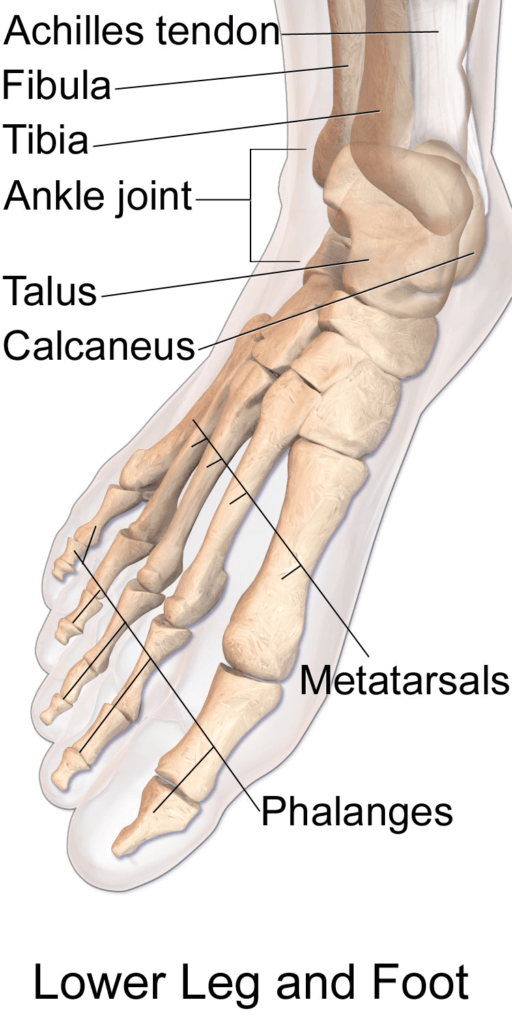
Our focus in this article is to prove you the best bang for your cadet talocrural joint mobility exercises to amend your ankle mobility, specifically ankle dorsiflexion, every bit this can cause problem up the kinetic concatenation if it is limited.
Stiff Ankles? Looking For An Exercise Program? We Have The 1 For Y'all!
If your mobility is limited due to an injury/surgery in the past, or you're simply dealing with potent ankles that are limiting your workouts and athletic performance, this program is appropriate for y'all as long as you lot take general conditioning feel! Click HERE to larn more about the program.
Why Do Yous Need Talocrural joint Mobility?
Ask yourself, on a daily basis do yous ever accept to…
- Put on shoes
- Squat down to choice something up
- Go up and downstairs
- Drive a car
- Sit downwards with your feet supported on the footing below you
Case of Ankle Dorsiflexion Going Downwards A Step

If you answered yeah to any of these questions (and trust me there are A LOT more), then you need to unlock ankle mobility! Talocrural joint mobility is an essential necessity for a lot of movements and activities of daily living. Talocrural joint mobility is but one of those things we take for granteduntil nosotros have information technology taken abroad from u.s.a..Have you always walked around in snowboard or ski boots? It tin can suck sometimes right?! That's because your talocrural joint mobility is restricted in those boots, thus move up the kinetic chain is affected! If you know someone that has experienced a badly broken or sprained ankle they will tell you having a stiff ankle is no fun and it affects them with a lot of movements.
READ: WHAT TO DO AFTER AN Talocrural joint FRACTURE
Ankle Mobility Deficits and Injuries
The big bulk of lower extremity injuries associated with talocrural joint mobility deficits like Achilles tendinopathies, dogie strains, and shin splints all kind of brand sense, right? If the ankle is limited in its power to dorsiflexion due to the tightness of the calf muscles, information technology may put more strain on the calf itself or the surrounding tissues. However, what about ACL injuries and plantar fasciitis? How is a lack of ankle mobility related to that?
ACL Injuries and Limited Ankle Mobility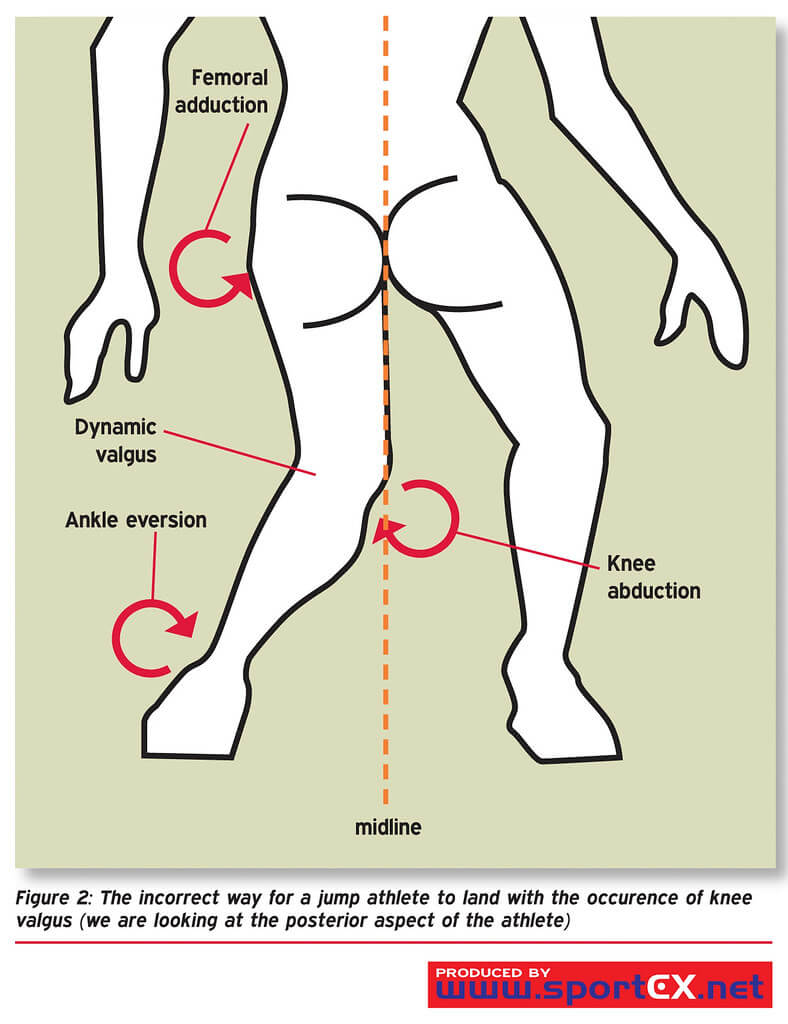
Talocrural joint mobility is very important for athletes, specially sports that involve jumping, landing, cutting, and pivoting motions. When it comes to uncontrolled knee valgus (knee caving in) and the motions nosotros don't want to see that tin contribute to ACL tears, we know the glutes and quadriceps play an important role in controlling knee position. Withal, we take to respect the fact that the talocrural joint also influences knee position in many functional tasks similar squatting, step downs, and even jumping (Dill et al., 2014). When athletes decelerate or land from a jump, the goal of our body is to apace absorb that bear upon. If an athlete has express talocrural joint dorsiflexion during landing, it means that their knee volition not exist able to move over the toes as much and the corporeality of genu bending will decrease (Fong et al., 2011). This inherently doesn't sound bad at first; nonetheless, the body volition ever take the path of least resistance. Meaning that to blot those forces, we will run into increased amounts of knee joint valgus along with other compensations at the rearfoot and midfoot joints with the arch collapsing, the shinbone rotating in, and the knee caving in. If we want to decrease the risk of ACL injuries, attacking limited ankle dorsiflexion with ankle mobility exercises is a very easy low hanging fruit for athletes (Amraee et al., 2014)
Plantar Fasciitis
Plantar fasciitis is one of the most common forms of heel pain that approximately ten% of the population will develop – if you're e'er had it before you know its no fun! Like to the landing instance above in ACL injuries, when nosotros walk our bodies will always accept the path of to the lowest degree resistance even if nosotros have express ankle mobility. To progress our bodies forward with each step, our arch will collapse and nosotros will overpronate through our midfoot, which puts increased stress on the plantar fascia! Furthermore, there is also a direct relationship between the fascia that connects the calf muscles, Achilles tendon, and the plantar fascia. Thus, by improving the flexibility of the dogie muscles along with performing talocrural joint mobility exercises, we can better outcomes for those with plantar fasciitis (Martin et al., 2014)!
READ: PLANTAR FASCIITIS PREHAB
Ankle Mobility Deficits and Squat Performance
For those that become under the barbell regularly, you know that express ankle mobility equals limited squat depth. That's why lifters have a heel drop to artificially give our ankles more range of motion! This allows the wearer to get deeper in their squat or receiving positions on cleans and snatches – all which can be the difference between a new 1RM or not!
The Secrets to Deep Squats: Tibia and Talocrural joint Mobility
This is a great video to learn a functional cess of ankle dorsiflexion with the deep squat movement too every bit a standing version of assessing weight-bearing isolated ankle dorsiflexion mobility. In this video, you'll acquire the secret to deep squats – unlock your tibia & ankle mobility. Not only exercise we examine the ankle, but nosotros also expect at the tibiofemoral, tibiofibular, and coupled move at other joints in the human foot and ankle!
What Can Limit Ankle Mobility?
Talocrural joint mobility in functional positions is usually defined past the ability of the genu to travel by the toes (no this is Swell! Check out THIS VIDEO to learn why) When looking at merely the ankle, dorsiflexion occurs at merely the talocrural joint. The talocrural articulation connects the bottom sides of your lower leg bones (tibia and fibular) to the talus bone of your foot. However, when determining what can limit functional talocrural joint mobility as a whole, nosotros take to look at more than simply the talocrural joint itself to determine possible areas of restrictions so we know which talocrural joint mobility exercises to prioritize! The 3 main things that can limit functional talocrural joint mobility are:
- the talocrural joint itself
- the soft tissues that run behind the joint which include the muscles and fascia/connective tissues
- the 1st MTP joint of the big toe
The Talocrural Joint Tin Limit Ankle Mobility
When our joints movement, the bones which brand upwardly the joint slide and glide in certain directions, which allows for the seamless movement that we are used to seeing! In the talocrural joint specifically, as we motility into dorsiflexion the talus glides backward within the ankle joint (similarly this can be thought of as the ankle joint moving forward on elevation of the talus). If the articulation becomes strong, it limits the ability of the bones to glide, and thus limit your talocrural joint mobility! This is usually ane of the showtime places to target to increment ankle mobility!
The Soft Tissues Tin can Limit Ankle Mobility
As the knee moves over and past the ankle, the soft tissues on the backside of the joint get stretched. If there is express flexibility/excursion of these tissues, it can too limit ankle mobility! Typically when people think of the soft tissues that limit ankle mobility, the triceps surae muscle which consists of the gastrocnemius and the soleus come to the listen. Even so, there is more than to our bodies than just muscles and basic. The connective tissue or fascia that connects the calf muscles to the Achilles tendon and to the heel also has an coaction with the plantar fascia on the lesser of the foot. Thus, both the calf and the plantar fascia must be addressed through ankle mobility exercises if they are limited.
The Large Toe Tin can Limit Talocrural joint Mobility
Merely as we've discussed how limited talocrural joint mobility tin can affect human knee position up the chain, express big toe mobility tin besides affect ankle mobility up the concatenation! Going back to gait in one case over again, one time we movement over our human foot and our ankle moves into dorsiflexion, we then push button off the ground with our back pes. This push-off motion requires a good deal of large toe mobility, 50-lx degrees (which nearly people simply practise not have)! As nosotros discussed before, our bodies will always take the path of least resistance. Thus, if our body knows we are lacking big toe mobility, in the push-off phase of gait our foot volition simply spin out and nosotros will progress by pronating through our midfoot and not by going through our end range of normal ankle dorsiflexion! The goal is to take 10,000+ steps a day, right? Each step is an opportunity for united states of america to maintain or improve our ankle dorsiflexion. However, if our foot is spinning out with each step we tin eventually lose our ankle mobility, peculiarly if nosotros are not using information technology with other functional tasks throughout the day similar deep squatting or going downstairs.
How To Assess Ankle Mobility
Now that we understand just how important ankle mobility is, we must first assess our ankle mobility! "Assess, don't guess!" The do good of assessing is that yous can establish a baseline value and track your progress as you perform your talocrural joint mobility exercises. This is something you lot tin really practice with our Ankle Dorsiflexion Overhaul [P]Rehab Program!
Below yous will discover our favorite pick to self-assess ankle mobility. It is important to watch the unabridged video and listen to the instructions/details as information technology can be easy to compensate and get imitation measurements. Equally long as it's done correctly, this examination has been shown to have adept reliability and allows measurement of error (Konor, Morton, Eckerson, and Grindstaff, 2012). This is a proficient assessment to start with because we are limiting degrees of liberty and removing the weight-bearing component. In a half-kneeling position with a wall nearby for support and balance, yous can focus on just moving at your ankle and getting a clean measurement!
Assess Your Ankle Mobility With This Examination!
Sample Talocrural joint Dorsiflexion Mobility Program Assessment Video
Talocrural joint Mobility Exercises
Improving ankle mobility is going to look similar to assessing ankle mobility! When it comes to ankle dorsiflexion, nosotros categorize the ankle mobility deficits by either joint (talocrural) or soft tissue (dogie muscles) limitations, while as well being mindful to look at the large toe joint. To be honest, trying to differentiate between the two for the average person would be challenging and may not exist the most of import thing to focus on. Yet, typical signs of joint limitations are pressure/awareness in the front of the ankle with ankle dorsiflexion whereas soft tissue limitations are typically noted with pulling sensations in the dorsum of the ankle/calf. All ankle mobility exercises are going to fall into one of the 2 categories of soft tissue mobility or joint mobility. For increasing range of movement, we are always going to recommend starting on soft tissue mobility first and so post-obit it up with articulation mobility work!
Soft Tissue Ankle Mobility Exercises
Working on increasing flexibility/decreasing tone of the gastrocnemius and soleus muscles of the calf can and volition improve ankle dorsiflexion. Some of the popular methods to do this include stretching, soft tissue massage, ultrasound, heat, cupping, and instrumented assisted soft tissue mobilization. Of the group, static stretching and soft tissue massage are the most efficacious, researched backed, and approximate what – easiest to perform. (Stanek, Sullivan and Davis, 2018 and Young et al., 2013).
When it comes to static stretching of the calf muscles, we must remember to stretch both the gastrocnemius and the soleus muscle. While both muscles have a like zipper to the heel bone via the Achilles Tendon, they originate on slightly unlike portions on the back of your leg. The soleus muscle originates on the dorsum of your shin bone (tibia), whereas the gastrocnemius originates on the back and lower end of your thigh bone (femur). Because the gastrocnemius originates college up higher up the knee joint in comparing to the soleus which originates beneath the knee articulation, we can preferentially bias stretching the gastrocnemius muscle by keeping the human knee straight when we motion into talocrural joint dorsiflexion.
If you're looking for only a really proficient calf stretch because they experience extremely tight, beneath you will find your traditional static gastrocnemius and soleus stretches. When information technology comes to warming upwardly before an athletic event, nosotros only recommend static stretching later on action versus before activity. However, when it comes to increasing talocrural joint mobility static stretching is extremely of import. The more time nosotros spend at end range the meliorate!
The following are some examples of our favorite static stretches. The beginning one in particular not only stretches the gastrocnemius because the knee joint is straight, but information technology also hits the plantar fascia that runs underneath our pes due to the position of the big toe in extension.
Isolated Gastrocnemius & Soleus Stretch
Sample Ankle Dorsiflexion Mobility Program Exercise
Sample Ankle Dorsiflexion Mobility Program Exercise
Dynamic 3D Calf Stretch
This is my personal go-to dynamic stretch earlier any blazon of running, jumping, or agility exercises. Due to the musculus fiber architecture of the gastrocnemius, certain muscle fibers will get stretched when you add together in angles to your calf stretch versus just moving in a linear fashion. Some say that letting the arch collapse on a 3 way stretch is bad, although nosotros'd argue that we are hitting other parts of the musculus and it doesn't seem to influence gains in talocrural joint dorisflexion (Johanson, Baer, Hovermale and Phouthavong, 2008). Less is more, you don't need to be ambitious with this or feel a really intense stretch, only call up of it as warming up your calf. I will combine this with heel raises before or afterwards as well to assist warm-upwardly the calf and unlock ankle mobility!
If you're feeling a lot of hurting/discomfort in your Achilles tendon versus your calf muscles, you may want to dorsum off. Stretching is not the best recipe for managing tendons, instead, you lot want to load it.Learn why by listening to our podcast with the master of tendons, Dr. Jill Cook.
LISTEN: TALKING TENDONS WITH JILL Melt
Calf Foam Rolling
Nosotros are demonstrating this with a foam roller here, but you can also utilise other things like a lacrosse brawl for more pinpoint soft tissue mobilization. Nosotros are big fans of pivot and stretch methods, which Arash goes over effectually the 1:10 role of the video!
Ankle Joint Mobility Exercises
Joint mobility exercises attempt to amend the slide and glide of the ankle! Typically we tin better set on a stiff ankle articulation by slacking the soft tissue around it (bending the knee) or by utilizing mobilization bands. These banded mobilizations are designed to endeavor to mimic a physical therapist whose transmission mobilization techniques are effective at improving ankle dorsiflexion (Marron-Gomez Rodriguez-Fernandez, A. and Martin Urrialde, J., 2015). While they await fancy and often times are performed wrong, they do hold merit as contempo research has demonstrated that this banded mobilization below is fifty-fifty more constructive at improving ankle dorsiflexion that static stretching alone (Jeon et al., 2015).
Ankle Dorsiflexion Distraction
Sample Ankle Dorsiflexion Mobility Program Practice
Unlock Talocrural joint Mobility With This Dynamic Ankle Mobilization
This tends to be my become-to ankle mobility practice before lower torso workouts, specially squatting! Spending a couple of minutes grooving the motion and working the directions that feel limited always helps to unlock ankle mobility.
Big Toe Mobilization
Sample Ankle Dorsiflexion Mobility Programme Practise
Remember the importance of big toe mobility! Nosotros can exercise all the talocrural joint mobility exercises we desire, just if we forgot to address the big toe, all that work could be for goose egg!
How To Make Your Mobility Gains Stick
We desire to be loud and articulate – we are non promising you will unlock ankle mobility forever with simply these exercises. Mobility is dynamic, it tin come and get. If you don't use it, you can lose it! However, if you work on something daily it tends to better and it tends to stick better than if yous don't do it. Mobility is more than but bones, joints, and muscles, there is a neuromuscular component too. Your encephalon and your body volition permit you lot to movement into a specific range of motion if you lot train it! Below are some of our favorite exercises to exerciseimmediately afterward the mobilizations and stretches shown above to unlock your ankle mobility and brand it stick!
Using a Weight Plate To Strength Dorsiflexion
Placing a weight plate under the forefoot is an extremely effective mode to forcefulness your ankle into that newly gained range of motion! Typically you will come across people with poor ankle mobility squat with their heels on a plate. This is to put their ankle in more relative plantarflexion so it allows them to go into more dorsiflexion circuit and thus a deeper squat. Putting a plate at the forefoot does exactly the opposite.This starts the foot in a relatively more than dorsiflexed position, and then when you descend you volition hit that bulwark faster! The goal is to continually drive into that barrier as you lot descend. While not necessary with every exercise, it is a way to avoid any compensations. While the post-obit two exercises are designed to maximize your available ankle dorsiflexion, you may not actually hit stop range due to a lack of force or balance.
Anterior Reach with slider
Endmost Thoughts
Ultimately, to unlock ankle mobility you accept to sympathise what contributes to information technology, how to appraise it, and how to manage it. With the tools and skills you've learned in this article, all y'all need is discipline and you lot'll be on your way to optimal movement throughout the kinetic chain
Desire More Talocrural joint Dorsiflexion With A PROVEN Program That Gives Y'all The EXACT Road Map?
Passive interventions yield passive results, you will have to earn your talocrural joint dorsiflexion mobility. With that being said, all yous have to do is commit to our plan and put in the work! The best office of the plan is that y'all volition gain admission to us as your [P]Rehab motility coaches. We are hither to assistance you now and into the future! Learn more HERE
REFERENCES
- Dill, Yard., Begalle, R., Frank, B., Zinder, S. and Padua, D., 2014. Contradistinct Articulatio genus and Ankle Kinematics During Squatting in Those With Limited Weight-Bearing–Lunge Talocrural joint-Dorsiflexion Range of Motion.Journal of Able-bodied Training, 49(6), pp.723-732.
- Fong, C., Blackburn, J., Norcross, M., McGrath, G. and Padua, D., 2011. Ankle-Dorsiflexion Range of Motion and Landing Biomechanics.Periodical of Athletic Training, 46(1), pp.5-10.
- Amraee, D., Alizadeh, M., Minoonejhad, H., Razi, M. and Amraee, Yard., 2015. Predictor factors for lower extremity malalignment and not-contact inductive cruciate ligament injuries in male person athletes.Knee Surgery, Sports Traumatology, Arthroscopy, 25(five), pp.1625-1631.
- Martin, R., Davenport, T., Reischl, S., McPoil, T., Matheson, J., Wukich, D., McDonough, C., Altman, R., Beattie, P., Cornwall, M., Davis, I., DeWitt, J., Elliot, J., Irrgang, J., Kaplan, S., Paulseth, S., Torburn, 50., Zachazewski, J. and Godges, J., 2014. Heel Hurting—Plantar Fasciitis: Revision 2014.Periodical of Orthopaedic & Sports Physical Therapy, 44(11), pp.A1 – A23.
- Konor, M., Morton, Southward., Eckerson, J. and Grindstaff, T., 2012. Reliability of Three Measures of Ankle Dorsiflexion Range of Motion.International Periodical of Sports Concrete Therapy, seven(three), pp.279-287.
- Stanek, J., Sullivan, T. and Davis, S., 2018. Comparing of Compressive Myofascial Release and the Graston Technique for Improving Ankle-Dorsiflexion Range of Move.Periodical of Athletic Training, 53(2), pp.160-167.
- Young, R., Null, S., Wholohan, A., Bradhurst, R. and Reed, Fifty., 2013. Interventions for increasing talocrural joint joint dorsiflexion: a systematic review and meta-analysis.Journal of Foot and Talocrural joint Research, 6(1).
- Johanson, One thousand., Baer, J., Hovermale, H. and Phouthavong, P., 2008. Subtalar Joint Position During Gastrocnemius Stretching and Ankle Dorsiflexion Range of Motion.Journal of Athletic Grooming, 43(2), pp.172-178.
- Marrón-Gómez, D., Rodríguez-Fernández, Á. and Martín-Urrialde, J., 2015. The effect of ii mobilization techniques on dorsiflexion in people with chronic ankle instability.Concrete Therapy in Sport, 16(ane), pp.10-15.
- Jeon, I., Kwon, O., Yi, C., Cynn, H. and Hwang, U., 2015. Ankle-Dorsiflexion Range of Motion After Ankle Self-Stretching Using a Strap.Journal of Athletic Training, 50(12), pp.1226-1232.
Disclaimer – The content here is designed for information & education purposes simply and is not intended for medical advice.
Virtually the author : Craig Lindell

four Comments
Related posts
Get your showtime program at ten% OFF
Revolutionize your health & performance with [P]rehab today.
Title
Source: https://theprehabguys.com/unlock-ankle-mobility/
Thanks for the kind words!
Hey guys! been post-obit your content for a while. I fabricated a affair thats helps people with exactly this. Saw u guys made some content at ShowUp. Chris actually taught alot of what I know. Is at that place anyhow nosotros tin connect and I can get you feedback on my device I made for ankle mobility. Its called Ankle Thingy. Would love to accept y'all try information technology out and tell me what you remember.
Hey Chris!
Cheers for your support and taking the time to follow our content! In regards to your research, please send us an email at info@theprehabguys.com. Thank you!