Daily as Feed Intake of a Beef Cow
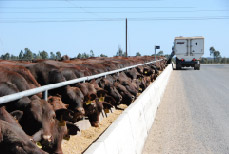 The key variables affecting the profitability of feedlots are: store cattle purchase price; finished cattle sale price; cost of feed consumed; and liveweight gain. This fact canvass deals with feed consumption and liveweight proceeds.
Feed consumption
Commodities used in feedlot rations vary considerably in dry matter content (DM). Hay and grain are approximately ninety% DM, molasses 75% DM and silage 40% DM. A bones guide for estimating dry out matter consumption of feedlot animals is to calculate 2.7% to 3.0% of their liveweight (in kilograms). Therefore, an fauna consuming a grain based diet of 90% DM, would have an estimated intake of fresh feed between 3.0% (2.7% x100/90) and 3.33% (three.0% x100/90) of their liveweight.
For case, heavy steers destined for the Japanese brusque fed market have an entry weight of approximately 450kg and a finished weight of 600kg, giving an average weight of 525kg.
Estimated daily fresh feed consumption (if consuming 3.0% of liveweight):
= (450 + 600)/ii 10 (3.0/100) = fifteen.8kg
Full fresh feed consumption for 100 days:
= 15.viii x 100 = 1,580kg
The dry affair content of a ration refers to the corporeality of dry fabric bachelor in a given ration. A number of factors influence the boilerplate daily dry matter consumption of lot-fed cattle. These include, liveweight (their required maintenance energy requirements), body condition, energy concentration of the ration, health status, and ration palatability.
Young animals and animals of lighter body condition may swallow greater than 3% of their body weight on a dry out matter basis equally they have a higher maintenance energy requirement, while older animals and animals in better body condition take a lower dry out affair intake approximating 2.vii%.
The energy of a ration is measured in megajoules (MJ) of metabolisable free energy (ME) per kilogram of feed on a dry matter basis. Metabolisable energy content of a ration can also effect consumption, with extremes in ME content reducing consumption relative to the optimum ME content of the ration. Palatability of the ration also furnishings consumption. Very depression DM content diets (less than 40%) tin can result in reduced dry matter consumption.
Feedlot managers usually find that cattle in backward shop status (drought afflicted) need to be held in the feedlot for extended periods to meet marketplace requirements. However, these cattle often swallow well over three% of their liveweight on a fresh feed basis and have exceptional liveweight gain. These fast gainers invariably have loftier feed conversion efficiency (liveweight proceeds: feed intake).
Liveweight gain
Variation in gut fill up tin have a large effect on liveweight gain and therefore must be minimised. The normal procedure with lot-fed cattle, if measuring for liveweight gain, is to weigh before the morn feed. This gives a benchmark time to piece of work from, as initial induction weights are taken with lilliputian or no gut fill. Standard weighing procedures need to exist adopted when determining liveweight proceeds.
In addition to gut fill up, many other factors can effect liveweight gain. The most important of these include age, sex, genetic merit, breed, body status, health condition, diet composition, diet food content, diet intake, growth promotant and previous nutritional history.
Noticeable variation occurs betwixt animals in relation to an optimum finish point. Older animals will achieve optimum stop faster than younger animals, as these animals are nearing the end of their growth period and volition partition most of their nutrient intake into finishing. Younger animals will partition a proportion of their intake towards skeletal and muscle evolution. Considering heifers mature before than steers, they volition normally finish sooner and may require closer supervision to avert excess fatty.
As a dominion, European breeds grow faster than British or Zebu breeds and tend to be leaner, but there can be every bit much variation within a breed every bit betwixt breeds. There is a wide genetic variation in the ability of animals to put on liveweight. Equally cattle stop, their rate of liveweight gain diminishes slightly. Health bug, whether information technology be acidosis, respiratory disease or from other causes, tin can be reflected in poor liveweight proceeds of individual animals. Nutrient deficiency (energy, protein, minerals and vitamins) can also cause a reduction in liveweight gain.
Growth promotants and rumen modifiers take proven to enhance liveweight proceeds. Any brake in feed or h2o intake, causes a reduction in liveweight gain.
The following table is a guide to probable daily liveweight gains for a number of lot-feeding systems.
| Market specification* | Boilerplate gain (kg/hd/day) | Range (kg/hd/day) |
|---|---|---|
| Domestic merchandise – steers | one.4 | i.1 to 1.7 |
| Domestic trade – heifers | 1.3 | 1.0 to 1.6 |
| Korea | 1.5 | 1.2 to 1.8 |
| Japan – brusque fed | 1.5 | one.2 to 1.8 |
| Japan – long fed | i.iii | 1.0 to ane.six |
*It is of import to know the marketplace specifications for finished cattle to determine the specifications of the store cattle entering the feedlot.
The above data shows averages accomplished for purchased store cattle, higher gains may exist accomplished with own cattle.
Farther information
Contact the Department of Agronomics and Fisheries Customer Service Centre on 13 25 23 (Queensland residents) or 07 3404 6999 between 8am and 6pm weekdays, or e-mail callweb@daf.qld.gov.au.
Sarah-Jane Forster, formerly Queensland Government.
Source: https://futurebeef.com.au/resources/beef-cattle-feedlots-feed-consumption-and-liveweight-gain/
0 Response to "Daily as Feed Intake of a Beef Cow"
Postar um comentário